Dividing Polynomials Long Division Calculator with Steps
Scope note
This page is a guide for dividing polynomials long division calculator searches. The calculator on this site currently handles positive integer long division only. It does not parse polynomial expressions such as x^2 + 5x + 6.
Use the Long Division Calculator for numeric division with quotient and remainder steps. Use this guide to understand what a dedicated polynomial long division calculator with steps should show.
Polynomial long division example
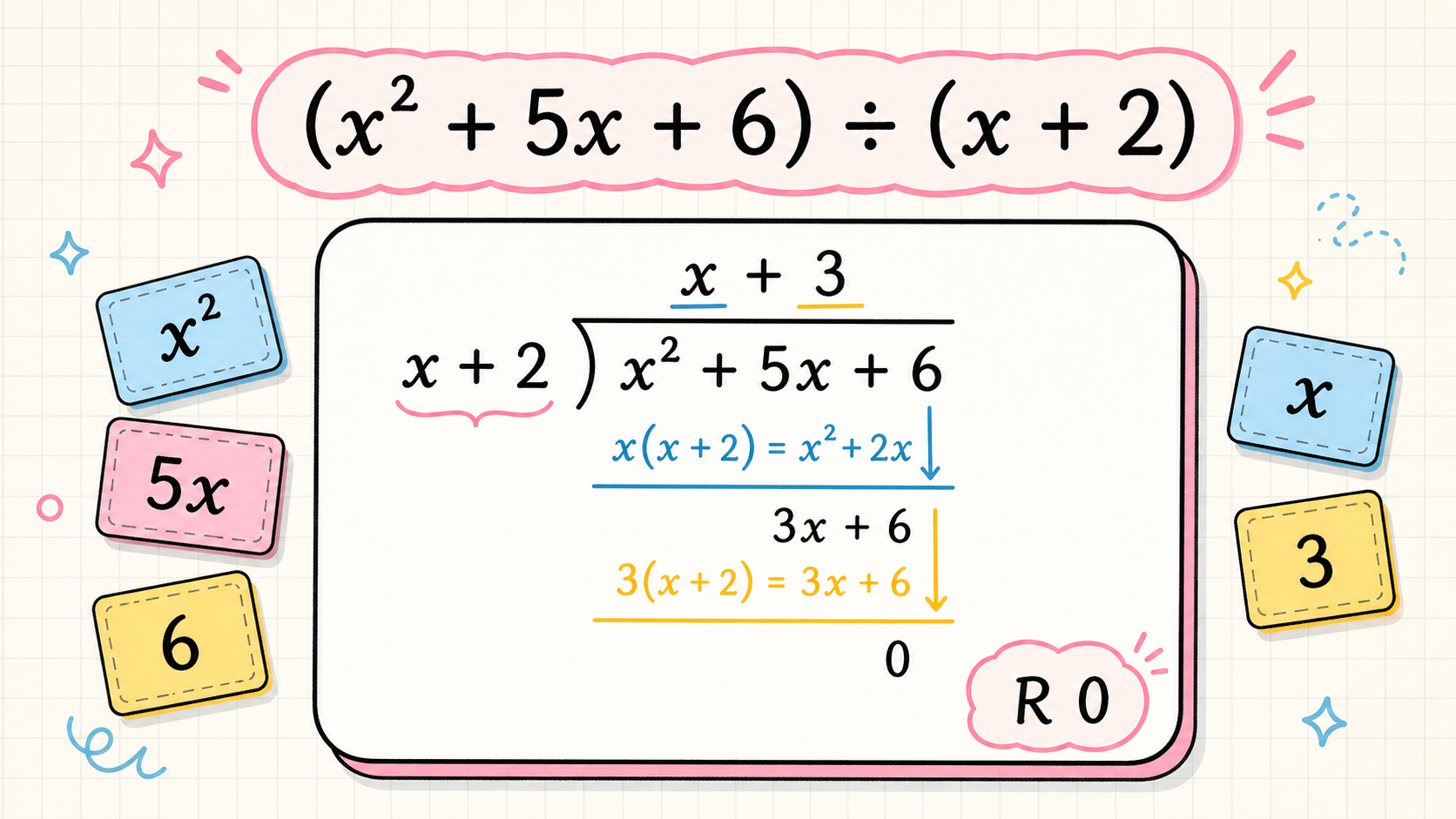
Divide:
(x^2 + 5x + 6) / (x + 2)
Step 1: divide the leading terms
Compare the leading term of the dividend with the leading term of the divisor:
x^2 / x = x
Write x as the first term of the quotient.
Step 2: multiply and subtract
Multiply the divisor by x:
x(x + 2) = x^2 + 2x
Subtract it from the dividend:
(x^2 + 5x + 6) - (x^2 + 2x) = 3x + 6
Step 3: repeat with the new leading term
Now divide the new leading term by the divisor leading term:
3x / x = 3
Write 3 as the next quotient term.
Step 4: multiply, subtract, and finish
Multiply the divisor by 3:
3(x + 2) = 3x + 6
Subtract:
(3x + 6) - (3x + 6) = 0
The result is:
(x^2 + 5x + 6) / (x + 2) = x + 3
The remainder is 0.
Example with a remainder
Divide:
(x^2 + 1) / (x + 1)
The quotient is x - 1, and the remainder is 2:
(x^2 + 1) / (x + 1) = x - 1 remainder 2
A future polynomial calculator should show the quotient, each multiplication line, each subtraction step, and the polynomial remainder.
Numeric division vs polynomial division
Numeric long division works with digits, quotient digits, subtraction, bring-down digits, and a numeric remainder. Polynomial long division works with terms, powers of x, coefficients, and polynomial remainders.
That difference is why polynomial long division should be handled as a separate calculator rather than mixed into the current integer-only tool.